1 min read

A feeling of understanding
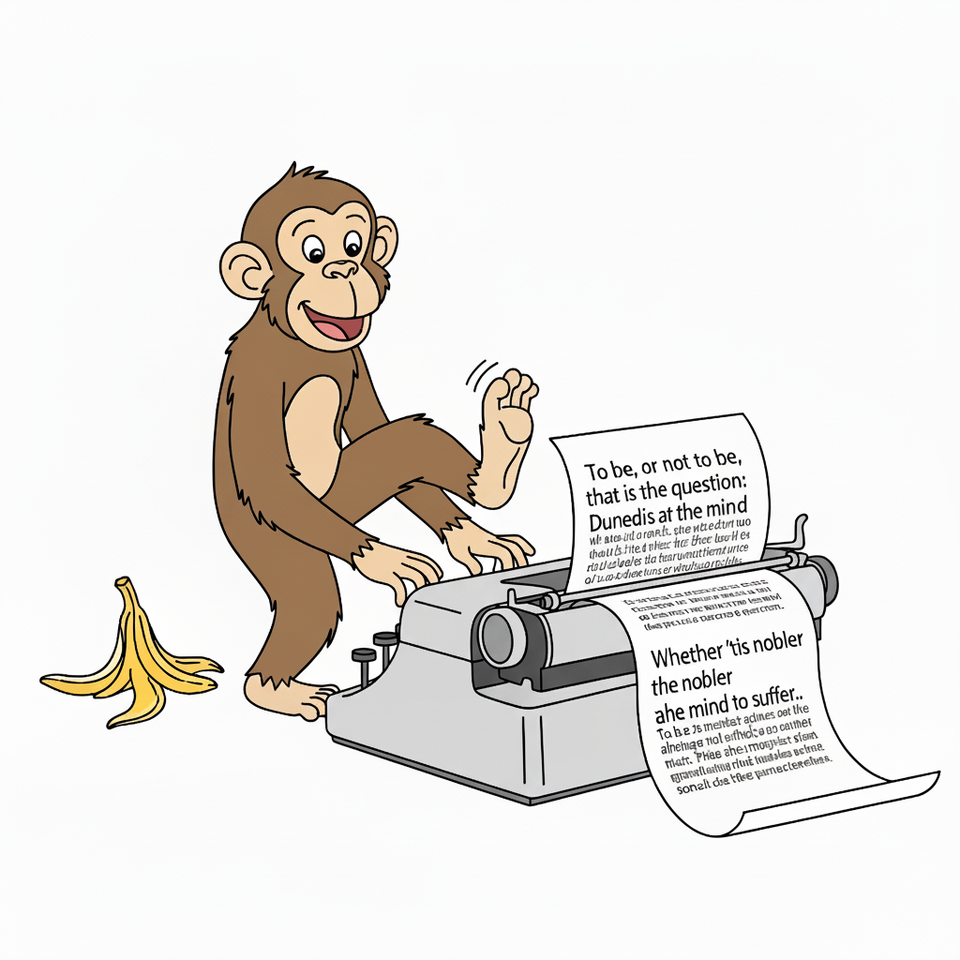
A cheerful cartoon chimpanzee (maybe a monkey; hard to say; probably a chimp?) tapping away at a typewriter and coming up with fragments of Hamlet by William Shakespeare.
Yup, the image above was generated by an algorithm with much prompting and prodding by me. (I used the embedded image generation tool in Google Slides.) I am intrigued by the difference in my feelings towards popping *this image* atop a note and my feelings towards *the note* atop which this image is popped. The image is based on my prompts and subsequent tweaking in both its content and form, *yes*, but I *in no way* drew this thing myself. And the difference is: I feel fine *popping* this, an image I in no way drew myself, atop a note whose every word and error and nifty turn of phrase and...*everything* I am fanatical about being *wholly responsible for in every sense*. I am, as I said, fanatical and prickly about this words; my current position regarding the use of generative algorithms is (*inter alia*) to never, *ever*, for ***as long as I live*** (which I hope is a long time!) *ever* send out a single verbal expression that is in any respect, in word or sentence construction or shape/structure or diction or 'oh that's a good metaphor maybe I'll' or *any*thing in any way derived from any generate tool. And when I say 'verbal expression' I mean everything: any language that I put out into the world, from emails responding to customer service agents at protein bar companies and texts to friends confirming that *yup* I will meet them where and when we had planned to the more obvious cases such 'notes' in the b-n-t and academic writing. (In terms of more quotidian communications, it has never happened that one of those canned responses to texts have in fact anticipated *exactly* what I would have said, meaning the exact wording and so on, and I have turned off the predictive sentence completion on my email platforms wherever possible so I don't see as many of those as one might (though, I still see some). BUT, in the cases where I haven't been able to turn them off, I have no objection, in the rare cases when the tool provides the last two or three words of a familiarly constructed sentence that is indeed *exactly* the sentence I was writing, to hitting *Enter* or [right arrow] or whatever it is that accepts the auto-complete, although this happens so rarely that it is almost always quicker for me to just finish typing rather than figure out/remember what key I'm meant to hit.) I find the notion of using words in that way—of presenting language that I prompted and tweaked but didn't *generate* on my own *as* being, in any sense, really, my own—objectionable on several fronts; I never want to do it. But, I mean, that is *not* how I feel about images! Why? To be clear, I don't at all mean that it's okay to present an image as my own production that's not. But I have no problem with coaching a tool through the generation of an image and putting that image atop content, a b-n-t note, that I would never let any such tool anywhere near. Why is that? Is it because I am not only not a visual artist but, further, someone who is exceptionally alienated from the production of visual images? I have an okay 'eye' in certain respects, I think, and I am an okay *photographer*, but my native ability to *generate* imagery is, like, *aphasically* bad. (I may feel this deficiency in myself especially keenly as the older brother to a younger sister who is gifted in this respect, but I think it's not just in comparison to a gifted sister that I am especially un-gifted in these ways.) Anyway. As I said, I think that in any and all such cases telling *you*, the audience, is at least *an* an important part of this whole thing, so this has been my way of doing just that. (Not that, perhaps, you even *needed* telling. Not only do these generative tools have stylistic markers as a class, including the probability that in a case such as mine they are what one might use, but each one individually—Gemini, Claude, ...GPT, *etc*.—has its own markers and *this* image is no exception.)

This is a placeholder note that will grow up to become a preamble followed by a b-n-tified pre-publication (ha! 😌; to be discussed below) of an academic paper (no ha! on this, which I'll also explain).

If you are looking for References for that paper, click the underlined word or just scroll to the end, which, for the time being, is right h

References

Kripke, S. (1980). Naming and Necessity: Lectures Given to the Princeton University Philosophy Colloquium, Byrne, D. and Kölbel, M., eds. Harvard University Press.

Kripke, S. (2013). Reference and existence: the John Locke lectures. Oxford University Press.

Putnam, H. (1975). The Meaning of 'Meaning', Minnesota Studies in the Philosophy of Science, 7:131–193.

Putnam, H. (1981). Brains in a Vat, in DeRose, K. and Warfield, T.A., eds., Skepticism: A Contemporary Reader. Oxford University Press.